
Research
Determining actual DNA editing outcomes in pooled single-cell CRISPR screens
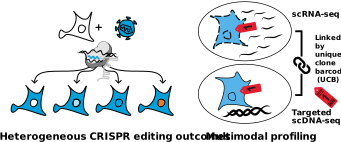
CRISPR editing in pooled single-cell screens generates a variety of outcomes at the DNA level, even from a single guide RNA. These include precise edits, insertions, deletions, and complex rearrangements. We use targeted single-cell DNA sequencing to recover these outcomes for each cell, enabling genotype-resolved transcriptomic analysis. This approach avoids relying solely on guide identity as a proxy for perturbation and allows for robust, outcome-aware modeling of effects.
Testing cell type specificity of effects
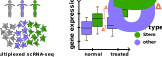
We evaluate how perturbations impact distinct cellular and patient contexts. In organoid models, this includes comparing differentiated and stem-like states, or assessing drug efficacy through pooled transcriptomic profiling of patient-derived organoids. Transcriptomic data enables annotation of cellular identities and stratification by patient of origin, allowing comparison of the effect sizes of identical editing or treatment outcomes across contexts. This informs context-dependent gene function, regulatory network structure, and therapeutic response, but requires careful hypothesis testing because measurements are not independent.
Improving estimation of total causal effects on gene expression

We aim to go beyond estimating direct perturbation effects by modeling total causal effects on gene expression. Assuming sparsity in direct targets and exploiting shared downstream responses, we improve effect estimation through outcome-aware regression models. This allows us to disentangle mediated effects and infer candidate causal intermediates. Ultimately, this helps identify functional gene modules and regulatory pathways perturbed by editing events.